
The Ultimate Philips 2000 Series Air Fryer Review: Testing the Master of RapidAir Technology
Is the brand that invented the air fryer still leading the pack in 2026? We dive deep into the performance, digital features, and crisping power of the Philips 2000 Series.
1. The Pioneer of Air Frying: Setting the 2026 Standard
If you are exploring the world of countertop convection, it is impossible to ignore the elephant in the room: Philips literally invented the modern air fryer. First introduced at the IFA consumer electronics exhibition in Berlin back in 2010, Philips held the patent on the “starfish” bottom design that defined the category.
Fast forward to 2026, and the market is utterly saturated. Hundreds of budget brands and premium competitors have flooded the shelves. Yet, Philips remains a benchmark for reliability and premium engineering. The Philips 2000 Series Air Fryer is positioned as their highly accessible, tech-forward daily driver. It strips away the unnecessary gimmicks found in some ultra-premium models and focuses purely on what matters: pristine airflow, an intuitive digital interface, and consistent, perfectly browned food.
But does this machine justify its price tag when cheaper alternatives boast similar specs? In this exhaustive review, we analyze its build quality, put its RapidAir technology to the test, and see if it truly deserves a spot on your kitchen counter.
2. Design, Build Quality, and the “Starfish” Secret
Aesthetically, the Philips 2000 Series leans into modern minimalism. It features a matte and gloss blended exterior (typically available in deep black or slate gray) that resists fingerprints much better than full high-gloss models. The footprint is impressively vertical, meaning it takes up far less horizontal counter space than toaster-oven style fryers.
The Patented Starfish Bottom
The true genius of the Philips design isn’t the exterior; it’s hidden inside the basket. At the bottom of the cooking chamber lies a molded, swirling ridges pattern known as the “starfish.” When the high-speed fan blasts hot air downward, it hits this starfish pattern, which acts as an aerodynamic ramp, aggressively reflecting the hot air back up through the food. This creates a true 360-degree heat vortex.
Many competitors have flat bottoms, which causes the air to bounce chaotically, often leaving the bottom of your food soggy. Because of the starfish design, the Philips 2000 Series rarely requires you to shake the basket halfway through cooking to achieve an even crisp.
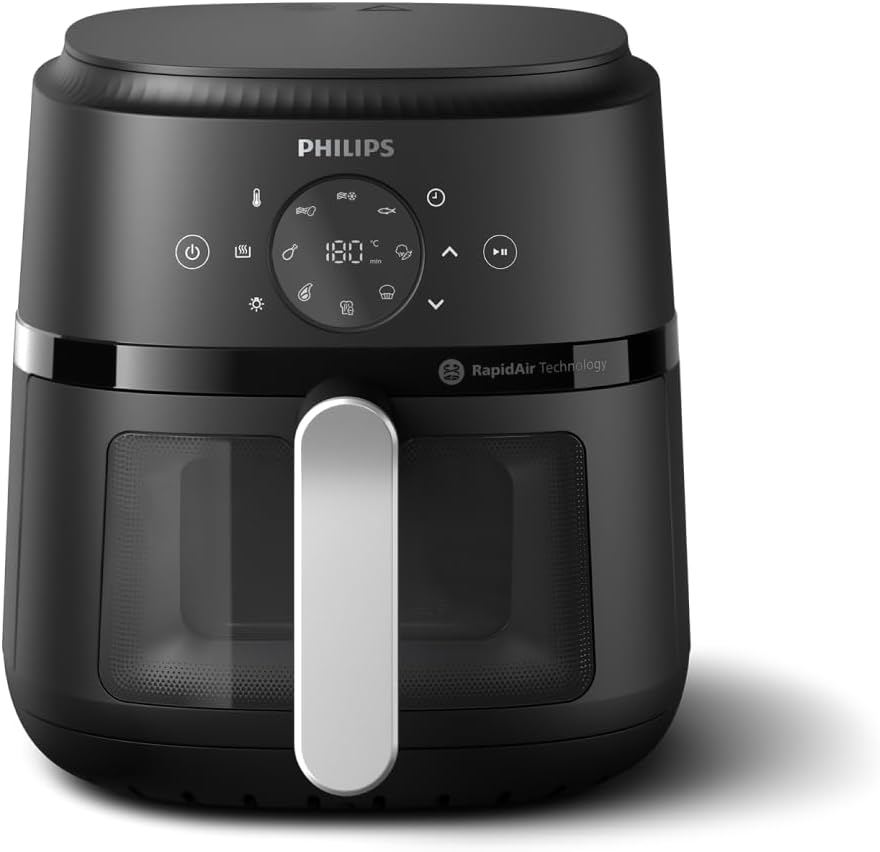
Philips 2000 Series Air Fryer (4.2L)
Experience the original RapidAir technology. Features a digital touchscreen, 13-in-1 cooking functions, and a compact footprint perfect for modern kitchens.
Check Price on Amazon3. Digital Interface: The 13-in-1 Cooking Experience
In the debate of digital vs manual air fryers, the 2000 Series plants its flag firmly in the digital camp. The sleek, front-facing LED touchscreen is incredibly responsive and highly intuitive.
It boasts 13 distinct cooking functions. While “Air Fry” is the obvious centerpiece, the machine is calibrated perfectly for Roasting, Baking, Grilling, and even Dehydrating. The one-touch presets take the guesswork out of daily meals. You will find dedicated buttons for:
- Frozen French Fries
- Fresh Potatoes / Root Veggies
- Chicken (Wings & Breasts)
- Fish & Seafood
- Baking (Muffins & Small Cakes)
- Keep Warm
For those who prefer manual control, the temperature can be adjusted seamlessly up to 400°F (200°C), and the timer extends up to 60 minutes.
4. Cooking Performance: Putting RapidAir to the Test
Specs are meaningless without results. We put the Philips 2000 Series through a rigorous culinary gauntlet to test the efficiency of the RapidAir technology.
- The French Fry Test: We loaded the basket with standard frozen crinkle-cut fries. Cooking at 390°F, they were shattered-glass crispy on the outside and fluffy on the inside in exactly 14 minutes. We did not shake the basket, yet the fries on the bottom were just as crisp as the ones on top.
- The Chicken Wing Test: The true test of an air fryer is rendering out chicken fat. At 400°F, a pound of wings took 18 minutes. The fat dropped safely below the crisper plate, and the skin was perfectly blistered, mimicking deep-fried results without a drop of added oil.
- The Veggie Test: Brussels sprouts and broccoli roasted beautifully at 375°F. The rapid airflow charred the edges quickly without turning the vegetables into mush.
5. Capacity and Sizing: 4.2L vs. 6.2L
Philips understands that households vary, so the 2000 Series is typically offered in two primary configurations. Choosing the right one is critical to your satisfaction.
| Model / Capacity | Best Suited For | Wattage Power | Footprint |
|---|---|---|---|
| 2000 Series (4.2L / 4.4 Qt) | Singles, Couples, or very small kitchens. Fits about 1 lb of fries. | 1300W – 1500W | Highly compact; easily stores in cabinets. |
| 2000 Series XL (6.2L / 6.5 Qt) | Families of 4-5. Can fit a whole small chicken or large batches of wings. | 1700W+ | Taller and wider; requires dedicated counter space. |
If you have the counter space, we almost always recommend the 6.2L XL version. Air fryers work best when food is placed in a single, uncrowded layer. The larger surface area of the XL basket makes a massive difference in cooking speed and crispiness.

Philips 2000 Series XL (6.2L Capacity)
Got a hungry family? Upgrade to the 6.2L XL model. Pack in a whole chicken, utilize the 1700W of power, and enjoy the convenience of the transparent viewing window (on select models).
Check Price on Amazon6. The Health Benefits: Slashing Fat and Acrylamide
One of the primary reasons consumers switch to air frying is the undeniable health benefits, and Philips champions this heavily. By utilizing rapid hot air instead of submerged oil, the Philips 2000 Series can cook your favorite “fried” foods with up to 90% less fat.
Furthermore, studies have shown that air frying drastically reduces the formation of dangerous compounds. If you want the deep science on this, read our report on air fryer health benefits and acrylamide reduction. By baking potatoes and starches via hot air convection rather than deep-fat frying, you mitigate the creation of acrylamide (a known carcinogen) by over 80%.
7. Cleaning and Maintenance: Truly Hassle-Free
An appliance you dread cleaning is an appliance you will never use. Philips designed the 2000 Series with everyday maintenance in mind.
The interior basket and the removable “starfish” crisper plate are coated in a premium, PFOA-free non-stick material. Foods like melted cheese, sticky BBQ sauce, and burnt sugar slide right off. Both the basket and the plate are certified dishwasher safe.
Pro Tip: While they are dishwasher safe, we highly recommend hand-washing them with a soft sponge and warm soapy water. The harsh detergents in dishwashers can degrade non-stick coatings over several years. A quick hand wash takes less than 60 seconds.
8. The NutriU / HomeID App Ecosystem
Hardware is only half the equation in 2026. Philips pairs the 2000 Series with their highly rated companion app, formerly known as NutriU (and recently rebranded in some regions as HomeID).
This is not just a gimmick. The app provides hundreds of curated recipes specifically calibrated for Philips air fryers. If you are new to convection cooking, checking out air fryer beginner recipes on the app takes the anxiety out of the process. It offers exact temperature settings, precise timing, and step-by-step instructions. For Wi-Fi connected variants of the 2000 Series, you can even push the cooking instructions directly from your phone to the air fryer.
9. Philips 2000 Series vs. The Competition
How does the pioneer stack up against today’s aggressive competitors? If you are torn between brands, we highly recommend reading our deep-dive on Ninja vs Philips air fryers. Here is a quick snapshot:
| Feature | Philips 2000 Series | Ninja Air Fryer (AF101) | Cosori Lite |
|---|---|---|---|
| Airflow Design | Patented Starfish Bottom (Superior evenness) | Flat Crisper Plate | Standard Crisper Plate |
| Max Temperature | 400°F | 400°F (Some models 450°F) | 400°F |
| Build Quality | Premium plastics, solid drawer glide | Durable, functional design | Modern, aesthetic focus |
| Price Point | Mid to Premium Tier | Mid Tier | Budget to Mid Tier |
While Ninja and Cosori often compete aggressively on price, Philips consistently wins on longevity and the sheer engineering perfection of its airflow dynamics.
10. Pros and Cons: The Final Summary
The Pros
- Unmatched Evenness: The starfish design eliminates the need to constantly shake your food.
- Intuitive Interface: The 13-in-1 touchscreen is incredibly user-friendly.
- Reliability: Philips motors and heating elements are built to last for years.
- Excellent App: The NutriU/HomeID app genuinely enhances the cooking experience.
The Cons
- Price: You pay a “brand tax” for Philips engineering compared to budget Amazon brands.
- Max Temp: Caps out at 400°F, whereas some competitors offer a 450°F “Max Crisp” mode.
- Basket Size: The base 4.2L model is too small for families; you must pay up for the 6.2L XL.

Maximize Your Philips Air Fryer
Unlock the baking and grilling potential of your 2000 Series. Grab the official Philips non-stick baking master kit and dual-layer grilling racks to double your cooking space.
Shop Philips Accessories11. Final Verdict: Is the Philips 2000 Series Worth It?
If you are looking for the absolute cheapest air fryer on the market, the Philips 2000 Series is not for you. However, if you view kitchen appliances as long-term investments, it is an absolute triumph.
The patented RapidAir starfish design is not a marketing gimmick—it is a verifiable feat of thermal engineering that delivers crunchier, more evenly cooked food than almost any flat-bottomed competitor. Combined with a beautiful digital interface and robust safety features, the Philips 2000 Series earns our highest recommendation as a reliable, daily-driver kitchen workhorse.
Buy the Philips 2000 Series Now


