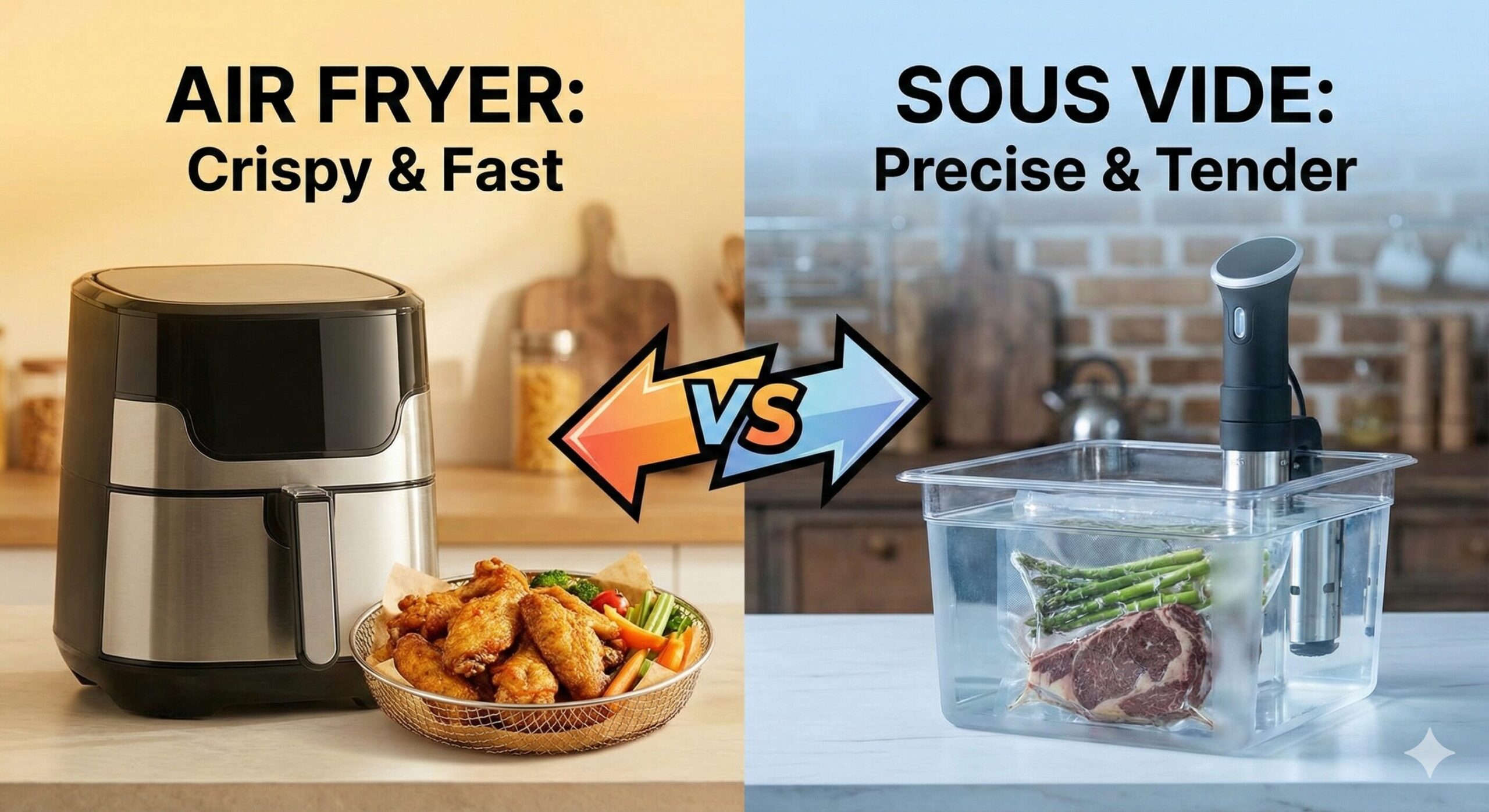
Air Fryer vs. Sous Vide: The Battle of Speed vs. Precision
In the world of modern cooking, there are two distinct camps. On one side, we have the “Fast and Furious” crowd: busy parents and professionals who want crispy, golden-brown food on the table in 15 minutes. On the other side, we have the “Low and Slow” perfectionists: home chefs seeking restaurant-quality steak that you can cut with a spoon.
This is the essence of the Air Fryer vs. Sous Vide debate.
These two appliances couldn’t be more different. One blasts food with superheated air; the other gently bathes it in warm water. One is about crunch; the other is about melt-in-your-mouth tenderness. But do you need both? Or can one appliance rule them all?
The Air Fryer Explained: Speed & Crunch
The air fryer has taken over kitchens globally for one reason: it mimics deep frying without the mess or calories. But how does it work?
An air fryer is essentially a high-intensity convection oven. A heating coil generates heat, and a powerful fan circulates that hot air rapidly around a perforated basket. This creates the Maillard reaction—browning and crisping the exterior of food while cooking the interior quickly.
If you are wondering about the versatility of this machine, you might be surprised. It’s not just for fries; check out what you can cook in an air fryer, from vegetables to desserts.
Pros of Air Fryers
- Speed: Cooks most meals in 10-20 minutes.
- Texture: Excellent for creating crispy skins and crunchy coatings.
- Versatility: Can roast, bake, reheat, and dehydrate.
Cons of Air Fryers
- Dryness: Because it uses intense hot air, it can dry out lean meats if you aren’t careful.
- Capacity: Basket space is limited compared to a water bath.

A powerhouse air fryer that offers OdorErase technology and a window to watch your food crisp up to perfection.
Check Price on AmazonThe Sous Vide Explained: Precision & Tenderness
Sous Vide (French for “under vacuum”) used to be the secret weapon of Michelin-star chefs. Now, it’s a stick you can buy for under $100.
The process involves vacuum-sealing food in a bag and submerging it in a water bath. A sous vide immersion circulator heats the water to an exact temperature (e.g., 129°F for medium-rare steak) and holds it there. The food cooks to that exact temperature from edge to edge, making it impossible to overcook.
Pros of Sous Vide
- Perfection: You get the exact same doneness from the center to the edge. No “grey bands” on your steak.
- Texture: Breaks down collagen in tough cuts of meat over long cooks (24+ hours), turning cheap cuts into filet mignon.
- Stress-Free: You can leave a steak in the water for an extra hour, and it won’t burn.
Cons of Sous Vide
- Time: It is slow. A chicken breast takes an hour; ribs can take 24 hours.
- No Sear: Food comes out of the bag looking grey and unappetizing. You must sear it afterwards in a pan or with a torch.

The most popular sous vide stick on the market. Connects to your phone so you can monitor your steak from the couch.
Check Price on AmazonHead-to-Head Comparison
| Feature | Air Fryer | Sous Vide |
|---|---|---|
| Primary Mechanism | Hot Air (Convection) | Warm Water (Conduction) |
| Cooking Time | Minutes (Fast) | Hours (Slow) |
| Best For | Wings, Fries, Veggies, Frozen Foods | Steaks, Roasts, Fish, Eggs |
| Texture Result | Crispy, Crunchy | Tender, Moist, Soft |
| Learning Curve | Easy (Plug & Play) | Moderate (Requires searing step) |
Texture & Taste Test
The biggest difference lies in moisture retention versus surface texture.
The Air Fryer Experience
Air fryers excel at dehydration. They pull moisture out of the surface of the food to create a crust. This is perfect for chicken wings or french fries. However, if you cook a steak in an air fryer, you risk the “bullseye” effect—well done on the outside, but potentially raw in the middle if the temperature is too high.
The Sous Vide Experience
Sous vide cooks in a sealed environment, meaning zero moisture loss. A chicken breast cooked sous vide is incredibly juicy, unlike anything you can achieve in an oven. However, it has zero crunch. To fix this, sous vide users often perform a “reverse sear,” where they cook the meat in water first, then flash-fry it in a pan with high-heat oil. For recommendations on oils that can handle this heat, read our guide on the best oils for high-temp cooking.
Health & Nutrition
Both methods are considered healthier than traditional deep frying, but for different reasons.
Air Frying: Significantly reduces fat intake because you are not submerging food in oil. You can cut calories by up to 70-80% compared to deep frying. We broke down these numbers in our article on air fried chicken vs. deep fried chicken calories.
Sous Vide: Requires little to no added fat during the cooking process. You are cooking the food in its own juices. Additionally, because the temperatures are lower and more controlled, there is some evidence that sous vide preserves heat-sensitive vitamins better than high-heat blasting.
Convenience & Workflow
Air Fryer: The king of convenience. You come home from work, throw seasoned chicken thighs in the basket, press a button, and eat in 20 minutes. It is a standalone, all-in-one solution.
Sous Vide: A multi-step process. You must prep the water bath, season and bag the food, wait hours for it to cook, remove it, dry it off, and then dirty a pan to sear it. It is a “weekend project” or a “planned ahead” meal, not a quick fix.
However, newer multi-cookers are blurring these lines. Devices like the Ninja Foodi combine pressure cooking, air frying, and sometimes even sous vide functions into one unit. See our comparison of Ninja Foodi vs. Instant Pot Air Fryer to see which hybrid might suit you.
Final Verdict: Which Tool Wins?
Get an Air Fryer If:
- You want to replace your microwave or oven for reheating.
- You love texture: crunchy fries, crispy skins, and roasted veggies.
- Time is your biggest constraint.
Get a Sous Vide If:
- You are obsessed with cooking the perfect steak or fish.
- You want to bulk-prep proteins (cook 10 chicken breasts perfectly, then freeze them).
- You enjoy the scientific side of cooking and have patience.
Pro Tip: Use them together. Sous vide your thick pork chops to perfect internal temperature, then air fry them for 3 minutes at 400°F to get a crispy crust without overcooking the inside. It’s the ultimate kitchen hack.
Frequently Asked Questions
Absolutely not. Plastic sous vide bags will melt instantly in an air fryer, ruining both the food and the machine. Always remove food from the bag before air frying.
It depends on preference. If you prefer texture and crunch, air frying tastes better. If you prefer melt-in-your-mouth tenderness and natural juices, sous vide wins.
Yes! This is a great technique. After sous vide cooking, pat the meat dry, brush with oil, and air fry at max temperature (400°F/200°C) for 3-5 minutes to crisp the outside.
Both are safe if used correctly. Sous vide requires careful attention to cooking times and temperatures to ensure pasteurization, especially at lower heats. Air frying is generally safer regarding bacteria kill-rates due to higher heat, but carries a small risk of acrylamide formation in starchy foods.
Sous vide is generally very energy efficient once the water is heated, as it only maintains temperature. However, because it runs for hours, the total consumption might be similar to running an air fryer for 20 minutes. Both are cheaper than a large electric oven.


