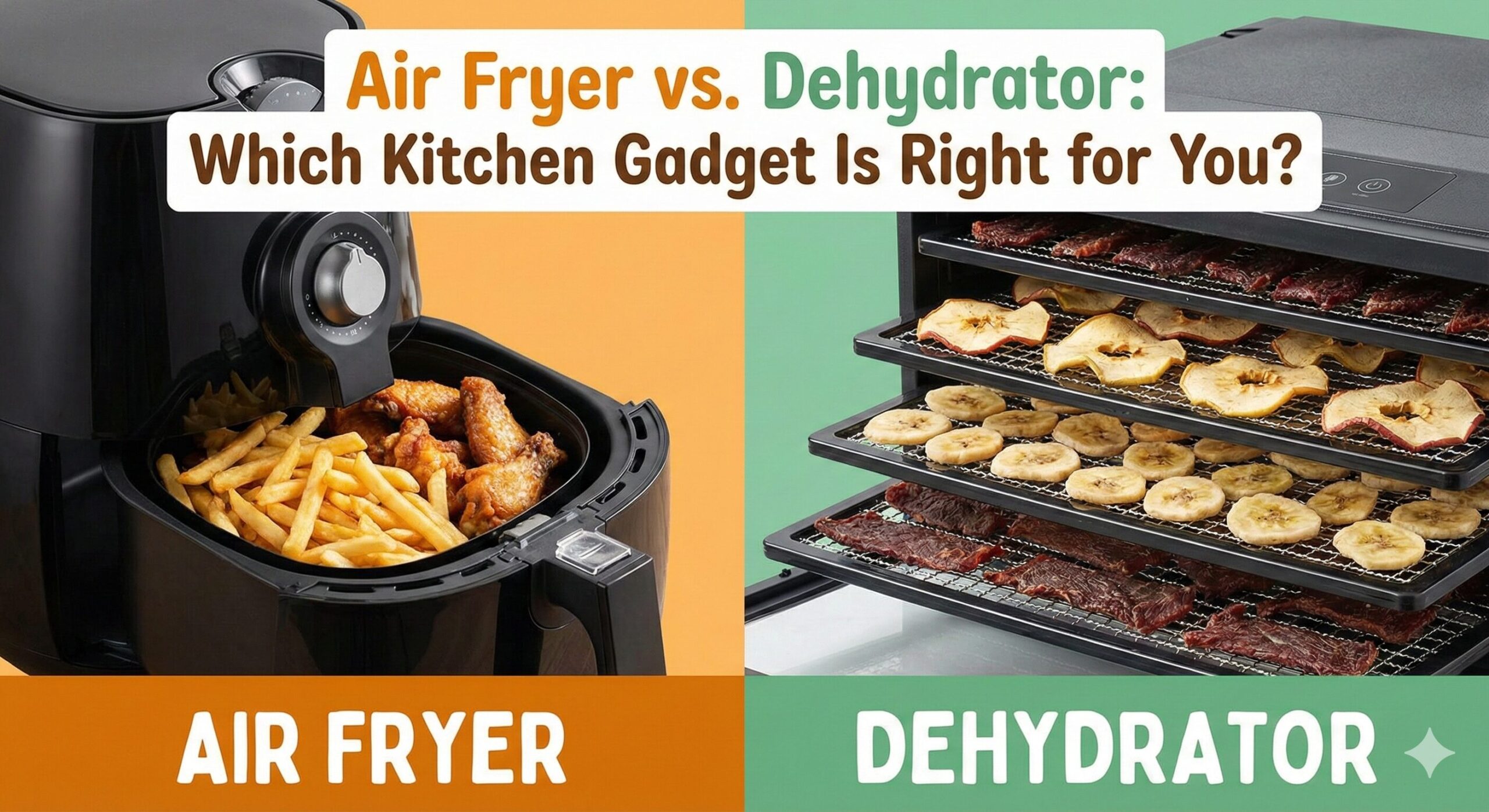
Air Fryer vs. Dehydrator: Do You Really Need Both?
The rise of homemade jerky, dried fruit chips, and preserved herbs has brought a new appliance battle to the kitchen counter: the Air Fryer vs. the Food Dehydrator.
Traditionally, if you wanted to dry food, you bought a dehydrator. It was a bulky, specialized machine with one job. But today, modern air fryers claim to do it all. They roast, they bake, they crisp, and now, many come with a “Dehydrate” button.
This leaves many home cooks wondering: Can I just use my air fryer to make beef jerky? Or do I really need to invest in a separate dehydrator? If you are exploring what you can cook in an air fryer, you might be surprised to find that dried apple chips and mango slices are on the menu—but the result might not be what you expect.
How Air Fryers Work (For Dehydrating)
An air fryer is essentially a high-intensity convection oven. It uses a heating element and a powerful fan to rush hot air around the food. Its primary goal is to cook food fast and create a crispy exterior.
When you switch an air fryer to “Dehydrate Mode,” the machine lowers the fan speed and drops the temperature significantly (usually between 105°F and 130°F). The goal is to remove moisture slowly without cooking the food. However, because air fryers are designed for high heat, maintaining these low temperatures for hours can sometimes be a struggle for cheaper models.
Pros for Dehydrating
- Speed: Air fryers tend to dehydrate faster than dedicated units because the fans are more powerful.
- Multifunctionality: You don’t need to store a “one-trick pony” appliance.
- Convenience: Great for very small batches (e.g., drying leftover herbs).
Cons for Dehydrating
- Tiny Capacity: You can only fit a single layer of apple slices in the basket. You can’t stack food.
- Flying Food: The powerful fan can sometimes blow lightweight herbs (like basil or oregano) around the basket.

This model is famous for its effective “Dehydrate” preset. The Ninja AF101 offers precise low-temp control, making it one of the few air fryers that can actually replace a dehydrator for small batches.
Check Price on AmazonHow Food Dehydrators Work
A dedicated food dehydrator is designed for “low and slow.” It uses a very low-wattage heating element and a fan that usually blows horizontally across multiple stacked trays (in shelf-style models) or vertically (in stackable round models).
The airflow is gentle and consistent, designed to pull moisture out of the center of the food without case-hardening the outside.
Pros of Dehydrators
- Massive Capacity: Even a small unit usually has 5+ trays. You can dry 5 pounds of jerky at once.
- Precision: They can hold very specific low temperatures (like 95°F for raw food diets) indefinitely.
- Even Drying: Horizontal airflow models dry everything evenly without needing to rotate trays.
Cons of Dehydrators
- Space Hog: They are bulky and hard to store.
- Single Use: They only do one thing. You can’t roast a chicken in them.
- Time: It can take 12-24 hours to dry fruit that an air fryer might finish in 4 hours (though with better quality).
Head-to-Head Comparison
Understanding the mechanism helps clarify the difference. Much like the comparison between an air fryer vs convection oven, it is all about how the air moves and how much space you have.
| Feature | Air Fryer | Food Dehydrator |
|---|---|---|
| Temp Range | 105°F – 400°F (Varies) | 95°F – 165°F |
| Capacity | Small (1-2 layers max) | Large (5-10 stackable trays) |
| Airflow | High Velocity (Turbulent) | Low Velocity (Consistent) |
| Best For | Quick snacks, cooking meals | Bulk preserving, gardening harvest |
| Noise | Loud Fan | Quiet Hum |
The Capacity & Workflow Issue
This is the deciding factor for 90% of buyers.
Scenario A: The Air Fryer User
You have two apples that are about to go bad. You slice them up, toss them in the air fryer basket, and in 2 hours you have a bowl of apple chips for movie night. This is where the air fryer shines.
Scenario B: The Dehydrator User
You bought 10 lbs of beef on sale, or your garden just produced 50 tomatoes at once. You need to preserve this food for the winter. An air fryer is useless here—you would have to run 15 separate batches over three days. A dehydrator handles this in one go.

If you are serious about jerky or preserving garden harvests, this stainless steel beauty is quiet, spacious, and built to last.
Check Price on AmazonDoes “Dehydrate Mode” Actually Work?
Yes, but with caveats. Many entry-level air fryers have a minimum temperature of 150°F or 160°F. This is actually too hot for many dehydrating tasks.
- Herbs: Need 95°F – 105°F. Higher heat destroys the essential oils and flavor.
- Fruits: Need 135°F.
- Meats (Jerky): Need 160°F for safety.
If your air fryer cannot go below 150°F, you will end up with “cooked” dried fruit rather than “dehydrated” fruit. The texture will be brittle rather than leathery. However, one of the major benefits of using an air fryer is that if you have a high-end model, it likely has the sensor technology to manage these lower temps effectively.
Final Verdict
Stick with your Air Fryer If:
- You only want to make dried snacks (apple chips, kale chips) occasionally.
- You have a small kitchen and absolutely no storage space.
- You are okay with doing small batches (enough for 1-2 people).
Buy a Dedicated Dehydrator If:
- You make beef jerky regularly (it is much cheaper to make than buy).
- You are a gardener who needs to preserve herbs, tomatoes, and peppers.
- You follow a raw food diet and require precise temperature control below 115°F.
Frequently Asked Questions
It is difficult. Most standard air fryers have a minimum temperature of 170°F-180°F, which is too hot for dehydrating. It will cook the food rather than dry it. Check your manual to see how low the temperature dial goes.
Air fryers use higher wattage than dehydrators, but they run for shorter periods. However, efficient dedicated dehydrators are generally cheaper to run for long 12-hour cycles because they use very low wattage (often 300W-600W).
You likely overcrowded the basket. In an air fryer, air must circulate around every single slice. If they overlap, the moisture gets trapped. You must do a single layer at a time.
Yes, as long as the temperature reaches 160°F (71°C) to kill bacteria. Since most air fryers easily reach this temperature, they are actually quite good for making jerky, provided you slice the meat thinly.


