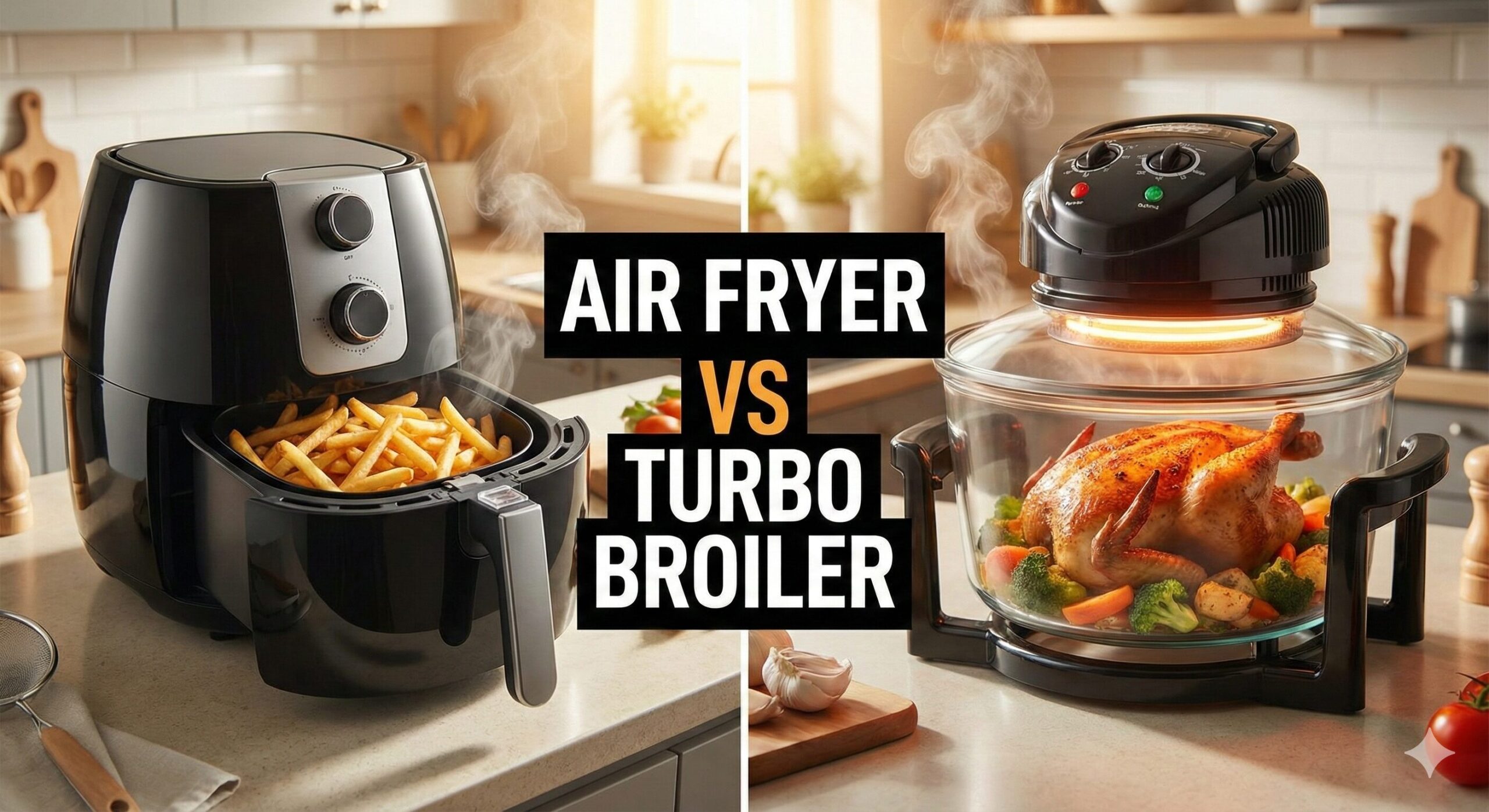
Air Fryer vs. Turbo Broiler: Which One Belongs on Your Countertop?
If you grew up in a household that loved Sunday roasts, you likely remember the “Turbo Broiler”—that spaceship-looking glass bowl that sat on the counter, glowing bright orange and humming loudly. It was the original countertop convection revolution. But today, a new challenger claims the throne: the Air Fryer.
Both appliances promise the same dream: faster cooking, less oil, and crisper results than a traditional oven. Yet, they are fundamentally different machines. Whether you are a home cook trying to replicate deep-fried texture or a meal-prepper roasting whole chickens, choosing between an Air Fryer vs. Turbo Broiler is a critical kitchen decision.
In this guide, we are stripping away the marketing hype. We will analyze the heating mechanisms, the energy efficiency, and ultimately, which one makes the better dinner.
Understanding the Technology
Before we look at the food, we need to understand the engine under the hood. At their core, both devices rely on convection heating—moving hot air around food to cook it evenly.
However, the execution differs dramatically. For a detailed breakdown of how this differs from standard baking, read our guide on air fryers vs. convection ovens. The primary difference lies in the heat source and the airflow velocity.
What is a Turbo Broiler?
The Turbo Broiler (often called a Halogen Oven or Glass Convection Oven) is instantly recognizable by its heavy glass bowl. The lid houses the mechanical components: a circular halogen lamp and a fan.
How It Works
When activated, the halogen bulb generates intense infrared light waves. This provides radiant heat, similar to the broiler element in your main oven or the coals of a grill. Simultaneously, the fan circulates the hot air within the glass bowl.
The “Turbo” Advantages
- Visual Control: The glass bowl offers 360-degree visibility. You never have to guess if your chicken is burning.
- Moisture Retention: Radiant heat seals the outside of meat quickly, often resulting in juicier roasts.
- Capacity: Most standard turbo broilers are 12-16 quarts, large enough to fit a whole turkey or a large rack of ribs.

The quintessential Turbo Broiler design. Huge glass capacity, infrared cooking, and perfect for large family roasts.
Check Price on AmazonWhat is an Air Fryer?
The Air Fryer is the modern evolution of convection cooking. It typically uses a compact plastic shell with a sliding drawer (basket). Inside, a metal coil heats up, and a high-velocity fan blasts air downwards.
Because the cooking chamber is much smaller than a turbo broiler, the heat intensity is concentrated. This rapid movement of superheated air mimics the effect of submerging food in oil. If you’re wondering why this is beneficial, check out the benefits of using an air fryer for a quick overview of health and speed advantages.
The “Air Fryer” Advantages
- The Crunch: The intense airflow removes surface moisture faster, creating a texture that rivals deep frying.
- Speed: Smaller volume means it preheats almost instantly.
- Safety: No hot glass to shatter, and the heating element is hidden safely inside.

The market leader for a reason. Ceramic coated basket, incredibly fast airflow, and dishwasher safe parts.
Check Price on AmazonHead-to-Head Comparison Chart
Let’s look at the technical specifications side-by-side to see which fits your lifestyle.
| Feature | Air Fryer | Turbo Broiler |
|---|---|---|
| Heating Source | Electric Coil (Convection) | Halogen Bulb (Radiant + Convection) |
| Primary Strength | Crisping & Frying | Roasting & Baking |
| Capacity | 4-8 Quarts (Average) | 12-18 Quarts (Average) |
| Preheat Time | 2-3 Minutes | Instant (Light on) |
| Material | Plastic & Non-stick Metal | Tempered Glass & Metal |
| Breakability | Low (Durable) | High (Glass bowl can shatter) |
Cooking Tests & Taste Profiles
Round 1: French Fries & Snacks
Winner: Air Fryer.
The Turbo Broiler struggles here. Because the bowl is large, the air doesn’t move with the same velocity as an air fryer. Fries in a turbo broiler often end up baked rather than fried. The Air Fryer, however, delivers that golden, audible crunch.
Round 2: Whole Chicken
Winner: Turbo Broiler.
This is where the halogen lamp shines. The radiant heat acts like a rotisserie, crisping the skin while the gentle convection cooks the meat without drying it out. Plus, fitting a 5lb chicken into a standard air fryer basket is a struggle; in a Turbo Broiler, it’s easy.
Cleaning & Durability
The “after-dinner” experience is just as important as the meal itself.
Turbo Broiler Maintenance
Cleaning a turbo broiler can be a workout. The glass bowl is heavy, bulky, and slippery when soapy. You have to be extremely careful not to chip it in the sink. The lid unit (containing the fan/light) cannot be submerged in water, making it tricky to wipe down if grease splatters up.
Air Fryer Maintenance
Modern air fryers are designed for convenience. Most baskets are dishwasher safe or feature high-quality non-stick coatings that wipe clean in seconds. If you want to keep your device pristine, we recommend looking into a dedicated cleaning solution. You can check our review of the best air fryer cleaning kits to prolong the life of your non-stick coating.
Final Verdict: Which One Should You Buy?
Choose the Turbo Broiler If:
- You cook large roasts (Chicken, Turkey, Pork Belly/Lechon) frequently.
- You prefer “monitoring” your food through the glass.
- You have plenty of storage space for the bulky glass bowl.
- You are on a budget (Turbo broilers are often cheaper upfront).
Choose the Air Fryer If:
- You want quick, crispy meals (Fries, Nuggets, Wings).
- You have a small kitchen and need a compact appliance.
- You hate washing heavy dishes.
- You want a safer option for teenagers or older kids to use.
Frequently Asked Questions
Technically, both are convection ovens. However, “Air Fryers” use high-velocity fans and coils in a small space for crisping, while “Turbo Broilers” use halogen lights and slower fans in a large glass bowl for roasting.
Yes! Turbo broilers are excellent for baking because you can see the cake rising without opening the lid. Just be careful with the top heating element; you may need to cover the cake with foil to prevent the top from burning before the inside is cooked.
It uses infrared radiation (heat), which is completely safe and natural—it’s the same heat you feel from the sun or a campfire. It does not use microwave radiation.
This is normal operation. The halogen bulb cycles on and off to maintain the set thermostat temperature. When the light is off, the fan continues to circulate the hot air.
Turbo broilers usually run at lower wattage (1200W-1400W) compared to air fryers (1500W-1800W). However, air fryers cook faster. For a 1-hour roast, a Turbo Broiler is slightly more efficient. For 15 minutes of fries, an Air Fryer is more efficient.


